The ChronologyA multidisciplinary research on the world chronology by Vedveer Arya
Chronology and Origins of Indo-European Civilizations
Reconstructing 16000 years of Indo-Eurasian Past
Foreword by Swami Vidyadhishananda Giri
The general academic consensus has long placed the dawn of Indo-European civilizations around 3000–2400 BCE, an era often indirectly aligned with the biblical flood narrative. Most academic studies place the upper limit at about 4000 BCE. However, the research presented in the ensuing chapters decisively challenges this restrictive view. This approach calls for a more open-ended inquiry driven by corroborative evidence drawn from multiple scientific and historical domains — unbound by faith-based assumptions. The study of ancient history stands at a crossroads today. The author envisages a way forward based on a multidisciplinary methodology that integrates traditional sources, archaeology, linguistics, epigraphy, archaeoastronomy, and the burgeoning field of archaeogenetics.
“Chronology and Origins of Indo-European Civilizations” sets the tone for a pioneering investigation by questioning the assumptions underlying conventional chronological models. It critiques the misplaced confidence in archaeological metal-based periodization (the Copper, Bronze, and Iron Ages) and the undue reliance on the ‘absence of evidence’ as ‘evidence of absence’.
This book exposes how even scientific data is not immune to presuppositions when scientific methods can be influenced by human bias. Carbon-14 (C-14) dating can misrepresent actual results when calibration curves leave a range of dates open to interpretation based on flawed historical timelines. Through careful literary analysis and reinterpretation of ancient texts, author Vedveer Arya argues in favour of an antiquity for Indo-European civilizations, tracing their roots to at least the Younger Dryas period (10700–9700 BCE) and potentially earlier.
The evidence includes tangible artefacts and ruins, such as submerged human settlements found in the Gulf of Cambay in Gujarat, Poompuhar in Tamil Nadu as well as archaeological sites like Göbekli Tepe in Turkey, and Bhirrana, Mehrgarh, and Rakhigarhi in north and northwestern India. The iron-smelting findings at Sivagalai in Tamil Nadu, India, date to 3345 BCE. These are all physical finds but there are also intangible yet invaluable gems of information to be found, such as Vedic references to a now extinct equine species with 34 ribs— Equus sivalensis— suggesting the Rigvedic period predated the Younger Dryas period.
The author further strengthens this thesis by engaging in the debate over the original homeland of Indo-Europeans. He meticulously reviews and critiques the four dominant hypotheses— the Pontic-Caspian Steppe, Anatolian, South of the Caucasus, and Caucasus-Lower Volga theories— each representing a competing narrative in the field. Where these theories falter due to limitations in dating methodologies or incomplete alignment with ancient literary records, this book presents a robust and coherent conclusion: India, particularly its northwestern region, was the cradle of the Indo-European linguistic, genetic, and civilizational heritage.
What distinguishes this work is not merely its provocative assertions but the empirical and methodological rigour that underpins them. Drawing upon ancient literary sources, such as the Rigveda, post-Vedic literature, and the Avesta, corroborated by archaeoastronomical dating, the author reconstructs a timeline that places the origins of Indic civilization around 14400 BCE.
This timeline is not a speculative stretch of the imagination but is substantiated by archaeoastronomical evidence presented by the author. Studies in archaeogenetics also support the long reach of peoples of Indic origin, including mitochondrial DNA lineages (notably haplogroups M and U) and genetic divergence from the Iranian plateau over 12,000 years ago.
Vedveer Ayra’s work outlines a critical period for the development of humankind that occurred in phases after the Last Glacial Maximum. The author establishes that the reconstructed chronology, when juxtaposed with the development of agriculture and the post-glacial intensification of the southwest monsoon in the Indian subcontinent, defines a unique period in the history of human civilization. Though we would call these civilizations ancient, this era of development is a very short evolutionary period compared to the nearly two million years of human evolution since Homo erectus first walked on Earth. Evolution tends to meander slowly but the relatively short span of about 16,000 years covered in this book speaks volumes about the civilizational fast track of Homo sapiens.
Scientific evidence indicates that significant climate changes occurred in distinct phases after the last major ice age. Indian monsoon patterns are considered to have had three accelerated phases of development: 16,100-14,600 years Before Present (BP), 13,600-13,000 years BP, and 12,400-10,400 years BP. Thereafter, the monsoon cycles attained regularity around 8,000 years BP. Among the distinct accelerated monsoon phases, a crucial phase in the Indian subcontinent was the time period between the two mini ice ages of Older Dryas (12800-12500 BCE) and Younger Dryas (10700-9700 BCE). The author is able to match the phases with his reconstructed chronology, coinciding with the development of Sanskrit and the simultaneous agrarian revolution that included the plant-based diet of an organized, agriculture-based civilization. Incidentally, Vedic Sanskrit transitioned into post-Vedic Sanskrit following the period of the Younger Dryas and the disappearance of the Vedic Sarasvati River, ushering in a period of post-Vedic Sanskrit literature for 2,000 years (9400-7400 BCE), when no more Vedas were composed.
This book outlines the civilizational developments arising from the dominant meteorological conditions that intensified the annual summer monsoon in India around 15000 BCE. Summer monsoon rain is a weather pattern we can still see today in large parts of India and Asia. The favourable summertime southwest monsoon fostered the preconditions for agriculture to develop in India. Starting during the same period, the Sanskrit language emerged in India, developing a structure based on over 2,400 distinct root sounds, the majority of which are found in other languages, primarily among the Indo-European language groups.
The author’s research verifies the long-held thesis based on my own unbroken monastic oral history that the two developments were interrelated as agriculture and plant-based dietary options provided the basis for sustaining settlements and organized human civilizations, while a sophisticated language structure provided the means to communicate abstract ideas.
Linguistic research has shown that Indo-European languages evolved in an area where agriculture developed. While an all-encompassing epistemological model with data from multiple fields remains to be scientifically validated, a clear pattern of evidence has emerged, showing that farming and the roots of Indo-European languages evolved together in India. Names of indigenous plants, trees, and vegetables from early farming in India are thought to have contributed words to Sanskrit and other Indo-European languages.
My monastic oral history claims that India was the place of origin of the first ever agriculture-based economy that helped bring society together into an organized civilization. Vedveer Arya’s book gives the historical context for this long-held thesis, opening a fascinating line of inquiry that could further explore whether the onset of agriculture and the integration of a plant-based diet brought about faster evolutionary advances for the Homo sapiens species.
Vedveer Arya makes a strong claim that Rigveda, the oldest written piece of literature in the world, was codified in written form between the Older and Younger Dryas, which is prior to 10700 BCE, except for minor additions. Recitation of Sanskrit verses meant the wisdom of the Vedas could be preserved through the ages based on an oral tradition. Many of the long-held beliefs of my monastic and Sanskrit lineages correlate closely with the timelines proposed in this book for ancient India and the period of codification of the Vedic Sanskrit literature.
Sanskrit’s structured grammar and the composition of rhythmic verses, channelled through the sages, were devised to facilitate the sure transmission of knowledge and ancient wisdom. The author himself is a Sanskrit scholar with a firm grasp of the vast expanse of ancient Sanskrit texts and manuscripts. He combines this understanding with an in-depth investigation using archeoastronomy based on the scientific mapping of the movements of celestial bodies. Vedveer Arya grasps the mathematics involved for the simulations and calculations when going back in time using astronomy software. Consequently, when crossing the threshold between dates in the Common Era (CE) and Before Common Era (BCE), it is essential to count the year zero (0 CE). Thus, Vedveer Arya brings a unique perspective by combining his understanding of archaeoastronomy with insights into the nuances of Sanskrit and traditional Indic history.
The avid reader will find that this book primarily addresses the chronology and migrations as they relate to the peopling of Eurasia after the last major ice age, after the Older Dryas, and subsequently after the Younger Dryas. Even though between 25000 and 18000 BCE the Indian subcontinent hosted a large human population, the author is focusing on the timeline of migrations from about 16000 BCE onward.
Vedveer Arya’s conclusions about migrations align with the genetic data to a large extent. Genetic research suggests that key human haplogroups (mitochondrial DNA U, R5; Y-chromosomal DNA R*) originated in India, implying prehistoric migrations from India to Siberia and Europe. Y-chromosomal DNA haplogroup R1a has been found to be prevalent in India, Central Asia, and Europe. In addition, high R1a1 and R2 diversity in India is indicative of the place of origin and does not support the hypothesis of migration to India from Central Asia or from any other outside region.
Furthermore, the author reaffirms that R1a (M17) evolved in India and then spread out of India about 16,000-15,000 years BP by migrations through Iran, South of the Caucasus, and Anatolia to Europe. Genetic study of West Asian Y-chromosome DNA aligns well with the conclusions that there was a human migration from India to West Asia indicated by the presence of Indic genes in the West Asian population (haplogroups: F*, L1, H [M-69], K2, C5, C*, R1a [M-17]), whereas West Asian genes (haplogroups: J1, G, I & R1b3) are not found in India.
Another main lineage which expanded after the Last Glacial Maximum, the haplogroup J2 (M172), is found principally in the Fertile Crescent and areas with good rainfall. The research and findings presented in this book align well with the assertion of genetic studies that the J2 haplogroup originated in India, possibly diversifying after the Last Glacial Maximum, 18,000 years BP. The J2 haplogroup being present in all segments of Indic society is considered to have spread through migrations out of India.
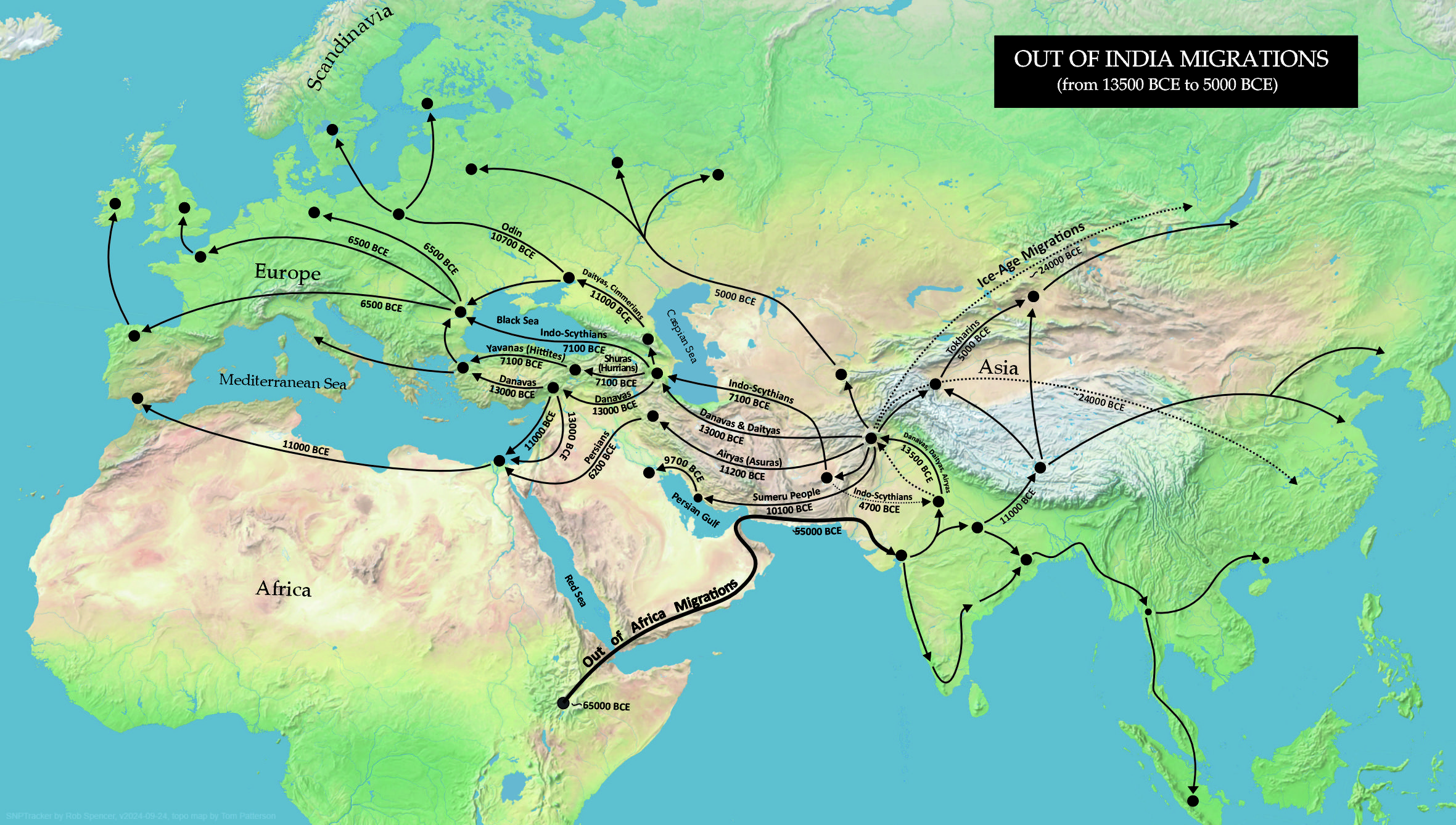
Vedveer Arya concludes that before 13000 BCE, the Danavas (Danaans) migrated from Sapta Sindhu to regions like Anatolia and onward to Greece. Archaeogenetic evidence, such as the discovery of the R1b haplogroup in Villabruna man (skeletal remains dated to 14,000 years ago, found in Italy), supports the direction of this early “Out of India” migration.
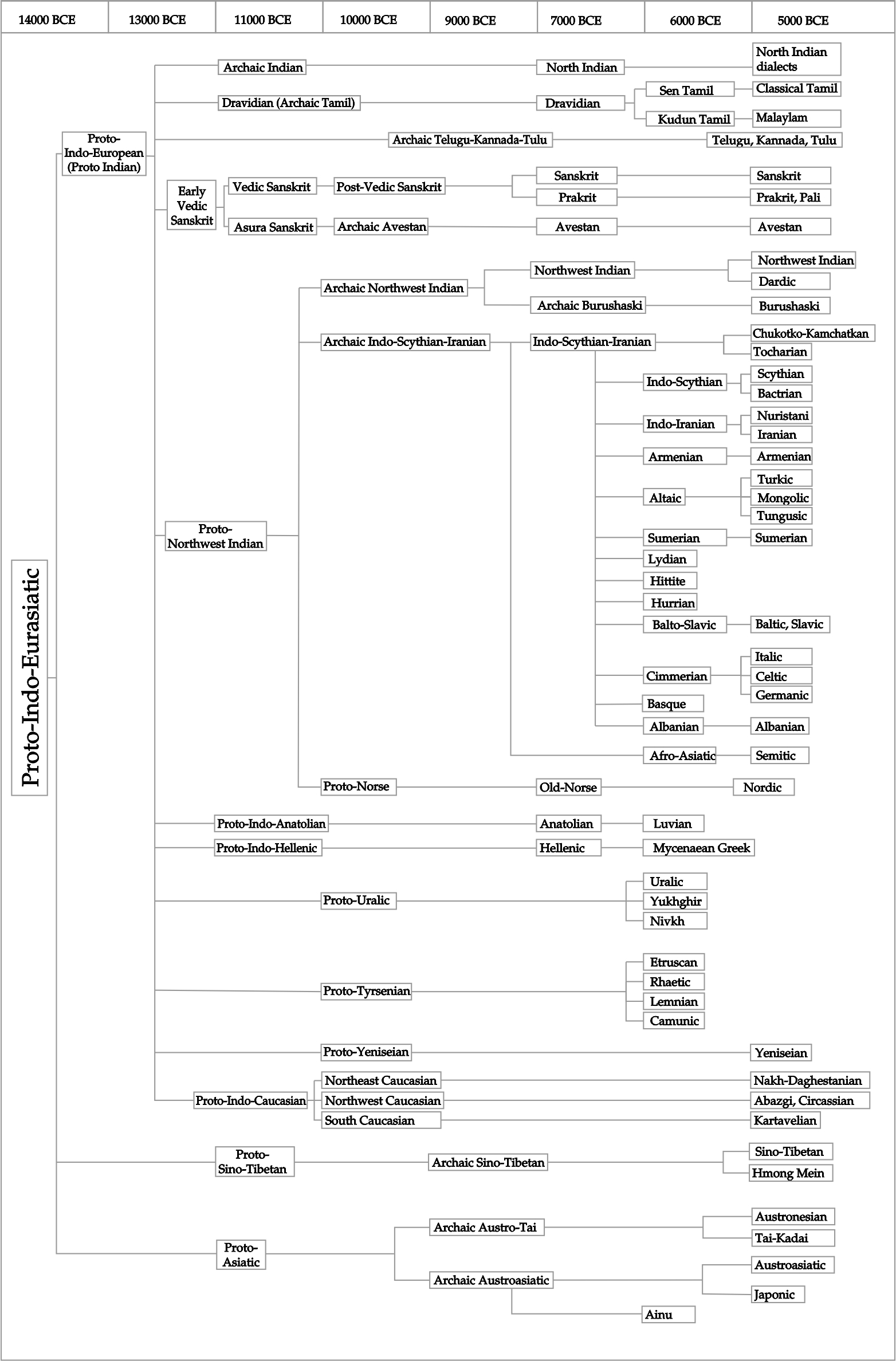
These migrations also spread the Proto-Indo-European (or more precisely Proto-Indo-Eurasiatic) language, connected with the roots of Vedic Sanskrit, archaic Tamil, and Proto-Anatolian— essentially the Proto-Indo-European tongue. Southeast Asia’s R1a presence and Austro-asiatic linguistic-genetic ties confirm Indic ancestry.
A second major migration occurred around 11200 BCE during the Rigvedic era, leading to Indian and Iranian population divergence. Genetic evidence indicates a substantial contribution of Indian mitochondrial DNA to the Iranian gene pool. Iranian legends also echo these migrations. By 9500 BCE, early Turks emerged from Indo-Scythian and Iranian interactions.
Vedveer Arya’s book explores the origins and chronology of the Sumerian and Mesopotamian civilizations among others. The author’s revised timeline introduces the intriguing possibility that agrarians of Indic origin contributed to the development of Fertile Crescent agriculture and even the emergence of the Sumerian civilization, as they spread westward in ancient times. There is plenty of circumstantial evidence from traditional sources and genetic studies to suggest that Indian agriculture predates that of many other organized agrarian civilizations.
Migrations out of India happened in many waves, as elucidated in Volume 2. Between 7400–6200 BCE, Greek traditions recall Indian-origin migrations of peoples such as Yavanas, Sakas, and Shuras who helped to shape Anatolian, Hurrian, and European civilizations. These waves deeply influenced the genetic, linguistic, and cultural foundations of Eurasian populations and Indo-European languages, highlighting India’s central role in human history, especially in relation to the branches of the Proto-Indo-European languages.
”Chronology and Origins of Indo-European Civilizations” revisits the “Out of India” theory, tracing multiple waves of Indo-European expansion westward from the Sapta Sindhu region between 14000 and 6000 BCE. These include the migrations of the Danavas or Danaans to Anatolia and Greece, the Asuras to Persia and the Caucasus, and subsequent groups influencing the rise of civilizations in Mesopotamia, Egypt, and Europe. Supported by genetic markers such as haplogroups R1a and R1b, whose earliest known presence in Europe is linked to Indic origin, this account defies the entrenched assumption that civilization flowed solely from the West and Central Asia to the East.
Recent genetic studies challenge the long-held assumption that haplogroup R1a1a (R-M17) originated solely in the Eurasian Steppe. High diversity and deep-rooted lineages of R1a1a, particularly within its Z93 branch, have been documented in India, suggesting an alternative origin narrative. Research studies have identified several basal and regionally distinct R1a subclades in India that either predate or are not represented in Europe or Central Asia.
Notably, the R1a-Z93 lineage— prevalent in India, Iran, and Central Asia— is virtually absent in Europe. Downstream markers like Z94 and L657 dominate Indian R1a samples, with some ancestral forms found exclusively in the subcontinent. Ancient DNA (aDNA) from the Eurasian Steppe does not show R1a presence prior to ~2000 BCE, whereas Indian lineages indicate diversification possibly as early as 6,000–8,000 years ago. These findings suggest that R1a-Z93 and its derivatives likely originated or diversified substantially within India, contradicting the conventional model of an influx of R1a to India from outside around 1500 BCE. This emerging consensus repositions India as a possible primary centre of R1a-Z93 evolution and diversification, warranting a significant re-evaluation of Indo-European genetic and migratory models.
One of the boldest assertions made in this book is its recontextualization of the biblical chronology, particularly the influence of the Ussher-Lightfoot model, which dated the creation of the world to 4004 BCE and became a de facto benchmark for centuries of Western historical thought. Through a forensic historical analysis, Vedveer Arya reveals how Enlightenment thinkers and academicians, such as Isaac Newton — despite their rationalist credentials — were still tethered to a chronology that was neither secular nor accurate.
Despite his scientific brilliance in defining the laws of motion, Newton’s work on chronology in the early 1700s was built on faulty assumptions by aligning the start of the Common Era (formerly known as the Christian Era) with an unverified date of Jesus’s birth (in 1 CE). This became a pivotal date that overruled past eras and traditional timelines causing Newton and other Christian scholars to distort the dating of events in pre-Christian civilizations such as those in Greece, Egypt, and Mesopotamia. This distortion, in turn, limits the ability of modern scholars to integrate new archaeological, genetic, or linguistic discoveries into a coherent historical framework.
A compelling argument woven through the chapters is that traditional literary sources— often dismissed as mythology— must be re-examined not as mere fiction but as vessels of encoded historical memory. The rejection of ancient sources such as the Sumerian King List, Indian Puranic literature, or Greek epics, perhaps simply due to their poetic or theological embellishments, undermines their historiographical validity. Instead, the author advocates for a balanced interpretation of the mythological narratives, extracting consistent genealogical and chronological successions that echo across cultures and can be validated through archaeoastronomical, genetic, and linguistic evidence.
Indeed, by restoring the authority of classical sources such as the Purana and Itihasa historical chronicles of India, Manetho’s Aegyptiaca, Berossus’s Babyloniaca, the Sumerian and Assyrian King Lists, Megasthenes’s accounts of Indian kings, and the Frankish Table of Nations, this book opens new avenues for integrating traditional historical narratives with scientific insights.
These sources suggest a far longer timeline for the dynastic histories of India, Greece, Persia, Sumeria, and Egypt— one that aligns more closely with the genetic, epigraphic, and archaeoastronomical evidence than with the compressed timelines sanctioned by archaeological assumptions influenced by biblical literalism. This mismatch is why the author argues that a multidisciplinary approach to chronology is not only desirable but imperative.
This comprehensive work also offers a thorough explanation and reconciliation of a 1,381-year chronological discrepancy in the dating of Buddha’s closure of earthly life, as well as a 661-year discrepancy concerning the birth of Jesus. These discoveries do not call into question the teachings of these world religions, only the timing of the life of their figureheads.
The chronology of India has also become distorted. Traditional Indic chronology dates the beginning of the Gupta Empire to around 334 BCE, with inscriptions from Samudragupta referencing the Kushano-Sasanians (Devaputra Shahishahanushahi in Sanskrit). It is a well-established historical fact that the Huns invaded Persia and India during the reigns of the Sasanian dynasty in Persia and the Gupta dynasty in India.
The traditional chronology of India clearly indicates that Chandragupta, the first king of the Gupta dynasty, ruled approximately 600 years after Alexander the Great. Drawing on traditional sources such as inscriptions, the author makes the case that Alexander the Great and the Achaemenid kings of Persia should be placed 661 years earlier than the Gupta Empire. However, many Indic scholars during the last two centuries have mistakenly regarded King Chandragupta and his successor Samudragupta of the Gupta dynasty as contemporaries of Alexander the Great. This resulted from attempts to fit in with the chronology imposed from outside India, which fixed the date of 323 BCE for the death of Alexander the Great as an anchoring point, albeit without a solid foundation. Despite their best efforts, Indologists have failed to convincingly reconcile Indian and world chronologies. Vedveer Arya has previously published a comprehensive chronology of India, rectifying these discrepancies. In this latest book, he ambitiously cuts through the current confusion caused by a variety of timelines in order to piece together compatible chronologies of Indo-European civilizations.
The author not only identifies the 661-year discrepancy in Indian and Western chronologies, but also draws attention to inconsistencies in the timelines of Middle Eastern civilizations. Addressing a challenge that has long perplexed modern historians and Egyptologists, he proposes an absolute chronology of Egypt from King Djer to Cleopatra, as well as of Babylonia and Persia from Abraham to Alexander the Great.
It would be an oversight not to highlight the broader philosophical implications of this work. At stake is not merely the chronology of one civilization or another, but our collective understanding of the whole civilizational storyline. When history is misdated, migrations misunderstood, and lineages misrepresented, then cultural identities are reshaped, often to the detriment of those whose voices lie buried in misclassified eras. In correcting these timelines, this book seeks to restore factual integrity by giving due weight to non-Western traditions and knowledge systems that have long been marginalized or exoticized.
The fundamental flaw in most modern interdisciplinary studies is the unverified adoption of a reduced historical chronology. After all, chronology is not merely a scaffold for placing events; it is the epistemological foundation upon which interpretations of origin, identity, and continuity are built. Without re-evaluating this foundation, scientific models, regardless of their sophistication, risk building castles in the air.
“Chronology and Origins of Indo-European Civilizations” by Vedveer Arya is not only a scholarly contribution, but also a call for intellectual courage and honesty. It dares readers, researchers, and historians to question entrenched assumptions, revisit neglected sources and embrace the complexity of due diligence. It champions a vision of history that is pluralistic, layered, and truly global — a history where ancient India is not an outlier but a cornerstone, not a backwater of civilization but one of its primal fountains.
As historians, scientists, and seekers of truth, we stand at the cusp of a paradigm shift. This work provides the necessary scaffolding for that shift — not by tearing down the past, but by illuminating it with tools more refined, data more expansive, and perspectives more inclusive than ever before. Let this book be read not merely as a counter-narrative, but as a pioneering framework for a revised timeline of the ancient civilizations of Eurasia. Let us acknowledge the limitations of earlier methodologies and bravely reconstruct the chronology and origins of Indo-European civilizations in the light of emerging evidence from multidisciplinary research.
Swami Vidyadhishananda Giri, PhD., DLitt et Phil
President, Self Enquiry Life Fellowship (Hansavedas), Penn Valley, California, USA
President, Vedic Heritage Research Foundation (Vedanidhi), Varanasi, India
President, Sri Paramananda Ashram Trust (a consortium of institutions), Prayagraj, India
Vice President, Tripura Yogashram, Haridwar, India
28 August 2025, California
Table of Contents (Volume 1)
S. No.
Title
Page
Foreword
vii
Preface
xviii
A Chronological Outline of Indo-Eurasia
xxii
Chapters
1.
The Need to Revise World Chronology
1
2.
The Year of Jesus's Birth and Anno Domini: A Historical Disconnect
26
3.
The Failure to Remove Four Extra Days in the Julian Calendar Reconstructed in 1582
59
4.
The Nabonassar Era and the Chronology of Persia
110
5.
Egyptian Civilization and the Sothic Calendar from King Djer to Cleopatra
181
6.
The Sumerian and Assyrian Civilizations
275
7.
Jewish History and Biblical Chronology
335
8.
The Roman and Byzantine Empires
369
9.
The Greek Civilization: from the Time of Olympians to Alexander the Great
396
10.
Chronology of Britain, Ireland, Scotland and Spain
449
Appendices
I.
The Dates of Nowruz (the Sun's Entry into Aries) Recorded by Abul Fazal
521
II.
The Chronograph of 354
540
III.
The Victorian Easter Table of 532 Years (626 BCE to 95 BCE)
545
IV.
The Easter Table of the 84 (14)-Year Cycle as Given in the Padua Manuscript
570
V.
Dionysius Exiguus's Easter Table of 95 Years (from 171 CE to 265 CE)
578
VI.
Babylonian Calendar of 14 Years (1294-1280 BCE)
603
VII.
Reconstructed Sothic Calendar of Egypt
610
VIII.
141 Historical Dates in the Sothic Calendar
624
IX.
Planetary Observations Compiled by Ptolemy
641
X.
Babylonian Calendar (2469-2448 BCE)
652
References
660
Bibliography
694
Index
707
Table of Contents (Volume 2)
S. No.
Title
Page
Chapters
11.
Origins of Scythians, Cimmerians, Arattas, Persians, Hittites, Hurrians, Romas and Tocharians
1
12.
Indian Civilization: Reconstructing the Yuga Calendar and Its Ancient Timeline
57
13.
Medieval India: Resolving the Discrepancy of 661 Years
180
14.
The Chronology of Nepal and Sri Lanka
333
15.
The Chronology of Burma and Southeast Asia
389
16.
The Chronology of Tibet
420
17.
Chinese Civilization: from the Xia Dynasty to the Yuan Dynasty
448
18.
Original Homeland of Indo-Europeans
490
Appendices
XI.
The Saka era (583 BCE) and the Sakanta era (78 CE)
552
XII.
A Comparative Study of Akbarnama and Tabakat-iAkbari
565
XIII.
The 37 Solar Eclipses Recorded in the Ch’un-Ch’iu Chronicle
571
XIV.
Solar Eclipses Observed During the Reign of the Han Dynasty and the Later Han Dynasty
583
XV.
Findings from Genetic Studies Related to the Indian Origin of Haplogroup R1a
602
References
660
Bibliography
694
Index
707
The Chronological Table
Date / Range
Event Description
Anchor Type
Key Sources / Notes
~72000 BCE
Toba super-eruption; volcanic winter; severe population decline in South Asia and South East Asia.
Climatic
Palaeoclimatic studies
~68000–60000 BCE
Wave of migration out of Africa.
Archaeogenetic
Archaeological & genetic studies
~60000–50000 BCE
Homo sapiens migrated to India; spread to SE Asia and Australasia.
Genetic
Archaeogenetic studies
~50000–45000 BCE
Cro-Magnons migrated from W. Asia to Europe; interbred with Neanderthals.
Genetic
Palaeogenomic data
~40000–18000 BCE
The Indian subcontinent became the most populous region in the world.
Genetic
Atkinson (2008)
~38000–33000 BCE
Neanderthals became extinct.
Archaeogenetic
Palaeolithic data
~29000–28000 BCE
Y-haplogroups R and J originated in India.
Genetic
Sengupta (2006), Sharma (2009)
~24000–22000 BCE
Haplogroup R-M173 (R1) migrated from India to south Siberia.
Genetic
Underhill (2010)
~22000–18000 BCE
R1a (M420) & R1b (M343) diverged in India; J2 split into J2a & J2b.
Genetic
Sharma (2009)
~15400–14100 BCE
First intensification of the southwest monsoon in India.
Archaeological
Qingfeng Ma (2019)
~15000–14000 BCE
From Siberia, humans crossed Beringia, reaching the Americas.
Genetic
Palaeogenomic data
Date / Range
Event Description
Anchor Type
Key Sources / Notes
~14400 BCE
The first civilization of Indo-Eurasia (Vedic agrarian civilization) was born in the Sapta Sindhu region of India; a calendar was based on the summer solstice at Dhanishtha nakshatra; the Proto-Indian language emerged.
Astronomical and multidisciplinary
Vedic texts and Puranas
~14000 BCE
Sage Brihaspati structured the Vedic Sanskrit language out of the Proto-Indian language on the banks of the Sarasvati River and taught it to 33 Devas.
Textual
Rigveda
~13900 BCE
War between Indra & Vritra; migration of Danavas, Daityas, and Airyas to the Hindu Kush region.
Textual
Rigveda and Puranas
~13322 BCE
Introduction of Vedic Yuga cycles: 5-year, 20-year, 1000-year; year began in lunar month Chaitra; autumnal equinox at Ashvini nakshatra.
Astronomical
Rigveda and Vedic Yuga calendar
~13300 BCE
Coronation of King Bharata (son of Dushyanta & Shakuntala) by Sage Dirghatamas.
Textual and astronomical
Rigveda, Puranas
~13500-13000 BCE
R1b of India found in Italy. Danavas (the speakers of the northwest Indian language) migrated to Anatolia → The Proto-Anatolian language evolved.
Archaeogenetic
Indo-Greek legends of Varuna and Uranus
~12000-11000 BCE
Danaans founded proto-Greek civilization; the Proto-Hellenic language emerged.
Linguistic
Greek-Vedic parallels
~11500-10700 BCE
Compilation of Rigveda, Yajurveda, Samaveda, and Atharvaveda. The mention of the Shivalik horse (Equus sivalensis) with 34 ribs in the Rigveda.
Textual and multidisciplinary
Vedic corpus
~11322 BCE
Introduction of 28-nakshatra system; Mrigashira became the first nakshatra; occurrence of the winter solstice at Mrigashira nakshatra.
Astronomical
Vedic corpus
~11200 BCE
Airyas (Asuras) migrated to Persia; Airyanam Vaejah (Azerbaijan) became the Asura power centre; Sarama Devashuni, messenger of Indra, met Panis on the banks of the Rasa River (Aras River) of the South Caucasus. Iranian-related ancestry diverged from Indian ancestry around 11000 ВСЕ.
Textual and archaeogenetic
Rigveda and Avesta, Shinde (2019)
~11000 BCE
War between Titans and Olympians in Greece; the first Trojan War also took place. Egypt was ruled by the descendants of Titans and Olympians. The giants in Greek legends were possibly Early European Modern Humans (EEΜΗ).
Textual
Greek
~11000 BCE
Odin migrated from the North Caucasus to Scandinavia; the Proto-Uralic languages were founded.
Textual
Ynglinga Saga
~10900 BCE
Southwest course of Vedic Sarasvati River lost at Vinashana (Uchana in Haryana) and Y1 channel of Yamuna, a major tributary of Sarasvati River, shifted due to tectonic activity.
Atlantis (possibly the Spartel Bank island) submerged by sea.
Textual, geological and bathymetrical
Greek historians
~10500-10100 BCE
People of Hindu Kush migrated to the Persian Gulf → Sumerian civilization began.
Textual
Early Mesopotamian texts
~9800-9700 BCE
Reign of Enmerkar, Gilgamesh, Utnapishtim; contemporaneous with the Aratta kings of India. The Persian Gulf was flooded during the reign of Gilgamesh.
Textual and records of sea level rise
Sumerian King List
~9500-9000 BCE
Fereydun had three sons, Iraj, Sham and Tur. Iraj became the king of Iran, and Tur became the king of Turan or Turkmenistan. Proto-Turkic & Proto-Altaic languages emerged in Turan.
Textual and linguistic
Persian texts and Altaic linguistic studies
~9500-9000 BCE
Sham ruled over Assyria and the region of Mesopotamia around 9000 BCE. His five sons, Ashur, Elam, Arphaxad, Lud, and Aram, were credited with founding Assyria, Elam, Ur Kasdim, Lydia, and Armenia.
Textual
Persian texts
~10700-9700 BCE
Post-Vedic Sarasvati River started flowing westwards through Ghaggar channel to Sindh and Rann of Kutch. This course of the Sarasvati dried up after the Mahabharata era.
Textual and palaeochannels
Palaeoclimatic and geophysical studies
~9322 BCE
Nakshatra Sukta of Atharvaveda was recompiled when winter solstice shifted to Krittika; Magha Shukladi Yuga calendar introduced to replace Phalguna Shukladi calendar of Rigvedic era.
Astronomical
Vedic calendar reform
~9000-8000 BCE
The Shivalik horse (Equus sivalensis) became extinct.
Archaeological
Archaeological studies
~7400-7100 BCE
Dionysus/Bacchus invaded India; his successors ruled for 300 years.
Greek-Indic link
Greek classical sources
~7100 BCE
Indo-Scythians & Sumeru people migrated to the Black Sea & Eastern Europe; they spread Indo-European languages.
Textual, linguistic and genetic
Indo-European linguistic phylogeny
~7000 BCE
Indo-Scythian kings Samothes, Gomer, Magog and his descendants founded their Scythian kingdom in Eastern Europe. The Sumeru people of India founded the community of Cimmerians in the Black Sea region.
Textual
Frankish Table of Nations and Holinshed's Chronicles
6778 BCE (22 February)
Surya Siddhanta epoch: Mayasura documented planetary conjunction on Chaitra Shukla Pratipada when the sun was in the first degree of Aries, introduced the weekday concept, and 22 February 6778 BCE was the first Sunday.
Astronomical
Surya Siddhanta Latin text
~6500 BCE
Frankish Table of Nations genealogical framework for Europe. Three sons of Alanus, a descendant of Magog, are the progenitors of 13 nations in Europe.
Textual
Latin text of Historia Brittonum
~6500 BCE
According to Historia Brittonum, the first man who dwelt in Europe was Alanus, with his three sons, Hisicion, Armenon, and Neugio. Hisicion had four sons: Francus, Romanus, Alamanus, and Brutus. Armenon had five sons: Gothus, Valagothus, Cibidus, Burgundus, and Longobardus. Neugio had three sons: Vandalus, Saxo, and Boganus. From this lineage, the nations of Europe arose.
Textual
Latin text of Historia Brittonum
~7000-6200 BCE
The people of Cessair from the Caspian Sea, descendants of Magog (Partholon, Nemed and Fir Blog) and then the kings of Tuatha de Danann people reigned over Ireland.
Textual
Lebor Gabála Érenn
~6200 BCE
Fenius Farsaid from Sistan reached Egypt; the progenitors of the Scots migrated north.
Textual
Lebor Gabála Érenn
~5905 BCE
Menes, a descendant of Mizraim (son of Sam and grandson of Gurshasp of Persia), founded the rule of the first dynasty in Egypt.
Textual
Manetho's Aegyptiaca
~6000 BCE
Sri Lanka separated from the Indian peninsula and became an island.
Bathymetrical
Meltwater pulse 1c
~5800 BCE
Raghu, king of Ayodhya, crossed the Indus and Oxus rivers and subjugated the Indo-Scythians and Bactrians.
Textual
Kalidasa's Raghuvamsha
~5677-5577 BCE
Ramayana era: Rama killed Ravana in 5635 BCE; became king of Ayodhya.
Textual, astronomical and bathymetryical
Valmiki Ramayana
~4800-3300 BCE
Decline of Ayodhya. Indo-Scythian and Bactrian occupation of northwestern India; Indo-Scythian script (Indus script) flourished; Mature Harappan phase.
Archaeological
The so-called Indus Valley civilization
~4500-3500 BCE
Migration of Tokharians from the Hindu Kush region of India.
Linguistic
Indo-European linguistic phylogeny
3605-2145 BCE
The first cycle of the Sothic calendar was introduced in Egypt in 3605 BCE during the reign of King Djer.
Astronomical
Egyptian sources
~3300-3250 BCE
The rise of the Bharata dynasty under the leadership of Shantanu led to the decline of the Indo-Scythian and Bactrian occupation in northwestern India. Gradually, the Brahmi and Kharoshthi scripts of India replaced the Indo-Scythian (Indus) script in northwestern India.
Textual
Vyasa's Mahabharata and Puranas
3162 BCE
Mahabharata War; Yudhishthira crowned as emperor of India.