Chapter 1
The Introduction
Ancient Indian history begins with Brahma, the founder of Vedic sciences, and his son Svāyambhuva Manu, the first king of the Brahmāvarta kingdom. A few kings and kingdoms may have existed before the lifetime of Brahma but the official recordkeeping of the genealogy of Indian kings and their history commenced from Brahma and his son Manu. Traditionally, the Sūtas and the Magadhas were entrusted with the task of maintaining this multigenerational chronological genealogy of the Manu and the Puru dynasties, charting their lineages since the early Rigvedic period. Though the two communities pursued their ancestral duty with utmost dedication, it was never a feasible expectation to maintain this continuity for thousands of years, which is perhaps why there are some gaps in the chronological genealogy of various dynasties.
These historical records had been formally compiled into Purāṇa-Itihāsa Saṁhitās for the first time by Veda Vyāsa’s pupil Romaharṣaṇa Sūta, during the later Rigvedic period. After this, the subject of Purāṇa-Itihāsa formally became a part of Vedic education and the pupils of Romaharṣaṇa Sūta also compiled Purāṇa Saṁhitās. The tradition of periodic compilation of Bhaviṣyat Purāṇa was introduced in the post-Vedic period. Then, the same Purāṇa Saṁhitās were recompiled in Laukika Sanskrit later, and came to be known as Purāṇas. It seems that the tradition of historical recordkeeping declined after the reign of the Ikśvāku King Agnivarṇa, the 25th descendant of Sri R ā ma. Kālidāsa abruptly ended his Raghuvaṁśa Mahākāvya after the reign of Agnivarṇa, probably due to a long interregnum in genealogical continuity of the Raghu dynasty. Evidently, the Ikśvāku dynasty had declined after the reign of Agnivarṇa.
Vyāsa, of the Mahābhārata era, revived the tradition of the study of Purāṇas and recompiled them into eighteen Purāṇas. Some Upapurāṇas were also compiled after the Mahābhārata era. The Purāṇas available to us, it seems, were finally recompiled and updated around 500-100 BCE. This revived Puranic tradition survived till the Gupta period. Only Bhaviṣyat Purāṇa continued to be periodically updated after the Gupta period.
Purāṇas narrate the continuous genealogical and chronological history of ancient India, starting from the Mahābhārata war, and the coronation of King Yudhiṣṭhira, and ending at the Gupta period. All Indian traditional and literary sources unanimously indicate the date of the Mahābhārata war to be in the 32nd century BCE and epigraphic evidence of the Aihole inscription conclusively establishes the date of the Mahābhārata war in 3162 BCE. Purāṇas refer to the Saptarṣi calendar that commenced around 6777 BCE, assuming the hypothetical position of Saptarṣis (the Big Dipper) in Aśvinī Nakśatra. Accordingly, Purāṇas, Vṛddhagarga and Varāhamihira, and other ancient scriptures unambiguously mention that the Saptarśis were in Maghā Nakśatra around 3177-3077 BCE, during the reign of King Yudhiṣṭhira. A reconstructed land grant of King Janamejaya, son of Parīkśit, was found in Tirthahalli district of Karnataka, which is dated in the 89th year of the Yudhiṣṭhira era (3073-3072 BCE). So, Purāṇas relate the complete genealogies of various dynasties of Magadha Empire after the Mahābhārata war. We also have sufficient epigraphic evidence starting from the reign of King Aśoka. Thus, we can factually and accurately establish the chronological history of ancient India from the Mahābhārata war (3162 BCE) to modern times, and we will discuss this in detail in the second volume of this book. The tougher challenge is to establish the chronology of ancient India beyond the date of the Mahābhārata war. Traditionally, Purāṇas follow the timeline of Chaturyuga cycle for narrating the chronological history of ancient India – however, the timeline of Chaturyuga cycle had been revised and enlarged during the post-Vedic and the post-Rāmāyaṇa eras with an objective to achieve accurate astronomical calculations in whole numbers, because ancient Indian astronomers preferred to work with whole numbers instead of odd fractions. Unfortunately, the original Purāṇa Saṁhitās written by Romaharṣaṇa Sūta and his pupils, the earliest versions of Purāṇas, have been lost long ago. In fact, it seems even the Rāmāyaṇa and the Mahābhārata have been recompiled during the Śātavāhana-Gupta period. The available versions of Purāṇas, and the Rāmāyaṇa and Mahābhārata relate numerous legends of the Vedic and post-Vedic period and also provide the genealogical information of various dynasties and lineages starting from the time of Vaivasvata Manu. Since the later timeline of Manvantaras and Chaturyugas consisted of the cycles of millions of years, it has been assumed that the great rishis and kings will be reborn in the beginning of Vaivasvata Manvantara. This may be the reason why the updaters of Purāṇas give almost all genealogies starting from the time of Vaivasvata Manu though they have propounded the beginning of the chronological history of ancient India from Svāyambhuva Manu. This contradictory assumption led to some chronological inconsistencies in the narratives of various genealogies as well as certain misplaced identifications of historical personalities with identical names. One of the biggest mistakes committed by the Puranic updaters is the misidentification of Veda Vyāsa of Rigvedic era as Vyāsa of the Mahābhārata era that led to the concocted concept of twenty eight Vyāsas and the impossible theory of eight chirajīvins. The later timeline of millions of years also misled the Puranic updaters to assign 60000 years to King Sagara and 11000 years to King Rāma and suchlike. The popularity of Adbhuta Rasa in Sanskrit poetry and drama, and the poetic exaggeration of narratives, had gradually transformed the historical legends into historico-mythological legends. These problems in the ancient Indian historiography led to the colonial notion that ancient Indians had no sense of history and lacked historical consciousness. Eminent historians, i.e. the touts of the colonialist, and Marxist Indian historiography have violently nurtured the same notion and promoted a deep-rooted hatred for ancient Indian historiography under political patronage. They have also sabotaged the efforts of some professional historians like RC Majumdar by branding them as “Hindu” historians, committed to the “Hindu version” of history. Evidently, most of our eminent historians have knowingly or unknowingly promoted a political ideology in academics rather than a professional research in the field of ancient Indian historiography. Over the last 200 years, the traditionalist but professional historians have continuously contributed a lot to rebut the false methodology of the colonialist and Marxist Indian historiography. Though they could not conclusively establish the authenticity of the factual tradition of ancient Indian historiography due to the chronological problems, they successfully exposed the numerous fallacies of the colonialist and Marxist Indian historiography. The unprecedented continuous resistance of the traditionalist historians has now forced eminent historians to rethink the colonialist and Marxist historiography. Gradually, they have started accepting that ancient India drew its sense of history from various sources including religious texts.
Romila Thapar, a living legend of the colonialist and Marxist historiography, has recently published a book entitled “The Past Before Us: Historical Traditions of Early North India” in which she clearly indicates a change in the mindset of the eminent historians. The Harvard University Press writes about her book: “The claim, often made, that India—uniquely among civilizations—lacks historical writing distracts us from a more pertinent question, according to Romila Thapar: how to recognize the historical sense of societies whose past is recorded in ways very different from European conventions. In The Past Before Us, a distinguished scholar of ancient India guides us through a panoramic survey of the historical traditions of North India. Thapar reveals a deep and sophisticated consciousness of history embedded in the diverse body of classical Indian literature. The history recorded in such texts as the Rāmāyaṇa and the Mahābhārata is less concerned with authenticating persons and events than with presenting a picture of traditions striving to retain legitimacy and continuity amid social change. Spanning an epoch of nearly twenty-five hundred years, from 1000 BCE to 1400 CE, Thapar delineates three distinct historical traditions: an Itihasa-Purāṇa tradition of Brahman authors; a tradition composed mainly by Buddhist and Jain scholars; and a popular bardic tradition. The Vedic corpus, the epics, the Buddhist canon and monastic chronicles, inscriptions, regional accounts, and royal biographies and dramas are all scrutinized afresh—not as sources to be mined for factual data but as genres that disclose how Indians of ancient times represented their own past to themselves.”
Though the mischievous subtitle “Historical Traditions of Early North India” is based on the colonialist divisive agenda to propagate the false theory that the history of early North India is somewhat different from that of early South India, and also to gain ideological dividends for Romila Thapar’s political patrons, I am glad that the eminent historian has finally understood the deep and sophisticated historical consciousness embedded in ancient Indian literature. Ancient Indian historical traditions are recorded in the Vedic corpus, Itihāsa texts (the epics), Purāṇas, Buddhist and Jain sources, Sanskrit and Prakrit poetic literature, regional accounts, inscriptions, Vaṁśāvalīs, monastic chronicles, traditional legends and more. Since the subject of this book is limited to the chronological history from the time of Manu to the Mahābhārata era, we need to establish the chronological historical traditions found in the Vedic corpus, the Purāṇa-Itihāsa texts and the Sanskrit literature written before the Mahābhārata era. First of all, we have to arrange the chronological order of ancient Indian literature. Pāṇiṇi indicates the three distinct stages of the evolution of Sanskrit language and grammar, i.e., Cḥāndasa (Vedic) Sanskrit, Post-Vedic Sanskrit and Bhāshā (Laukika) Sanskrit. Based on this linguistic evidence, the four Vedas were the earliest texts. Saṁhitās, Brāhmaṇas, Upaniṣads, Āraṇyakas, Sūtra and other texts were written in the Post-Vedic Sanskrit after the compilation of the four Vedas. Thereafter, Laukika Sanskrit texts like Nāṭyaśāstra, Smṛtis and Vālmīki Rāmāyaṇa were written. The traditional evidence also supports this chronological order of ancient Sanskrit literature. As already explained, the historical traditions beyond the Mahābhārata era have numerous chronological problems due to the enlarged Yuga cycles, mistaken and misplaced identification of historical persons with identical names and historico-mythological narratives. Therefore, we have to follow a scientific methodology to mine the factual historical data from Vedic and post-Vedic literary sources so that certain sheet anchors of the chronology can be firmly established. The internal archaeo-astronomical data of ancient Indian literature is the most credible evidence to unravel the sheet anchors of the chronology of ancient India. All ancient Indian chronological traditions follow the timeline of Yuga cycles. They unanimously relate that the present Yuga is the Kaliyuga, the 28th Chaturyuga of Vaivasvata Manvantara that commenced during the Mahābhārata era; however, there is a divergence of opinion about the exact epoch of the Kaliyuga. According to the Mahābhārata, the epoch of Kaliyuga commenced before the Mahābhārata war (3162 BCE). Most probably, the Mahābhārata indicates the commencement of Kaliyuga on 9th Jan 3176 BCE and Māgha Śukla Pratipadā, when the Saptarṣis were at Maghā Nakśatra. Āryabhaṭa indicates the commencement of the Kaliyuga at midnight on 5th Mar 3173 BCE, Chaitra Śukla Pratipadā in the 1st year of the 60-year cycle, i.e., Prabhava Saṁvatsara, when Jupiter was in Aries. The Bhāgavata tradition mentions that the Kaliyuga commenced after the death of Sri Krishna in the 36th year from the date of the Mahābhārata war whereas Lāṭadeva’s Sūrya Siddhānta indicates the commencement of Kaliyuga from 17th Feb 3101 BCE when all five planets, sun and moon were in close conjunction in Mīna Rāśi (Pisces). Thus, the epoch of Kaliyuga can only be conclusively established in the 32nd century BCE, between 9th Jan 3176 BCE and 17th Feb 3101 BCE. Interestingly, Lāṭadeva’s Sūrya Siddhānta says that Maya the great Asura wrote Sūrya Siddhānta at the end of the Krita Yuga of the 28th Chaturyuga of Vaivasvata Manvantara, when all five planets, sun and moon were in close conjunction in Meṣa Rāśi (Aries). This great conjunction took place on 22nd Feb 6778 BCE and Chaitra Śukla Pratipadā.
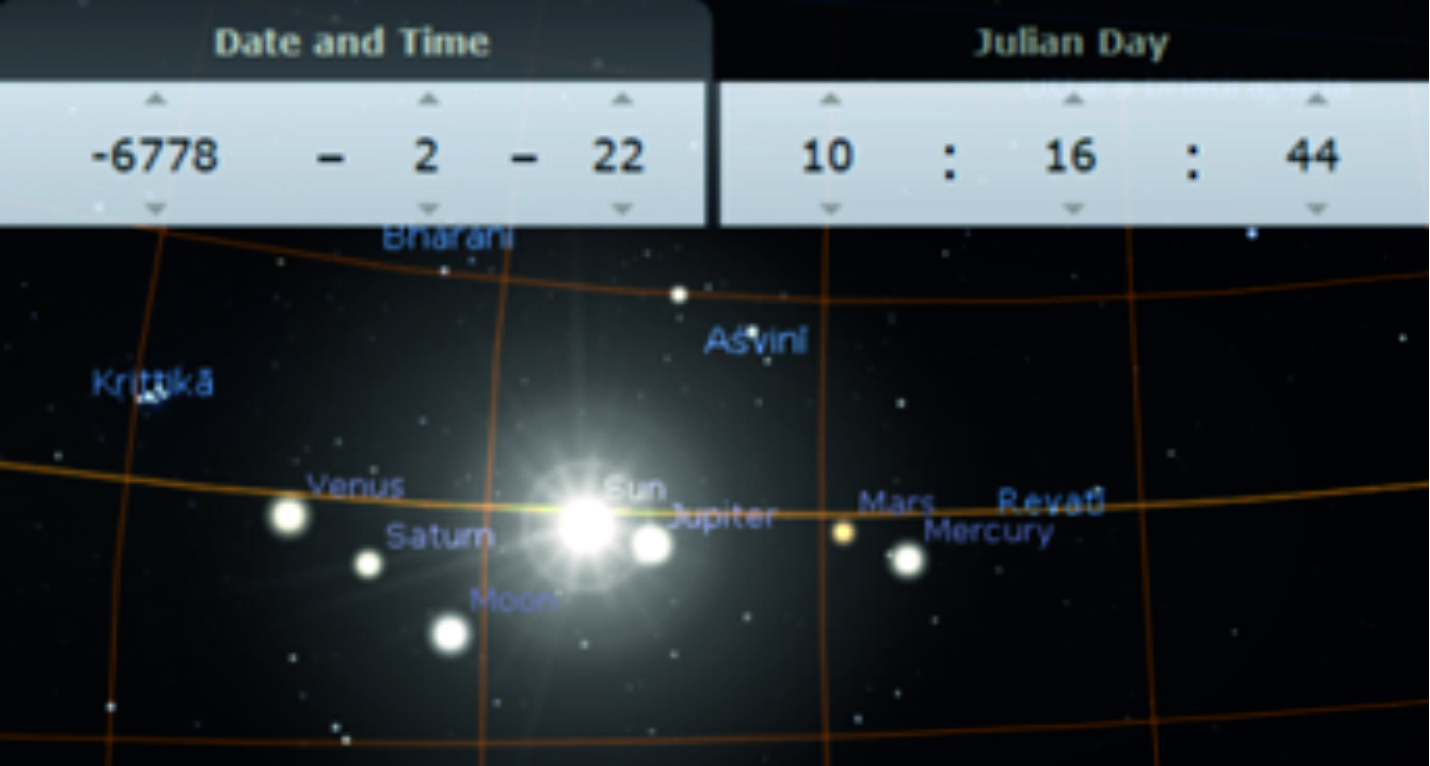
It seems Mayāsura considered this conjunction in Aries as an astronomical epoch and authored his S ū rya Siddhānta in 6778 BCE at the end of the 28th Krita Yuga of Vaivasvata Manvantara. This astronomical evidence of the conjunction of all planets in Meṣa Rāśi conclusively establishes the epoch of the end of the 28th Krita Yuga around 6778-6777 BCE. Thus, the beginning of the 28th Tretā Yuga can be conclusively established on 3rd Dec 6777 BCE, Māgha Śukla Pratipadā, based on the Māgha Śuklādi calendar of Vedāṅga Jyotiṣa. Brahma Siddhānta introduced the 12-year and 60-year cycle from 26th Feb 6773 BCE, Chaitra Śukla Pratipadā, based on the Chaitra Śuklādi calendar. The study of the entire Vedic corpus reveals that ancient Indians of Vedic and post-Vedic period followed only 5-year Yuga cycle and 20-year Chaturyuga cycle. There is no reference of the timeline of Manvantara cycle in Vedic corpus. The Jovian cycle of 12-year and 60-year cycle came into practice at the end of the 28th Krita Yuga in 6778 BCE. So, ancient Indians followed only the 5-year Yuga cycle before the beginning of the 28th Tretā Yuga in 6777 BCE. Ancient Indian chronological traditions indicate that a total of 1837 Yugas or 9185 years (1837 x 5) had elapsed before the epoch of the 28th Tretā Yuga (6777 BCE). Therefore, we can roughly establish the epoch of the Ādiyuga, or the first 5-year Yuga cycle of early Rigvedic period, in 15962 BCE. Hence, ancient India followed a continuous chronological tradition that commenced around 15962 BCE. In all probability, ancient Indians of early Vedic period had introduced the first 5-year Yuga calendar around 15962 BCE that might have reckoned from the summer solstice. The Mahābhārata states that Brahma introduced a calendar that commenced from Dhaniṣṭhā Nakśatra ( Dhaniṣṭhā distadākālo Brahmāṇā Parikīrtitaḥ ). This indicates that Brahma might have introduced the 5-year Yuga calendar when summer solstice was in Dhaniṣṭhā Nakśatra around 15000-14000 BCE. Therefore, I have roughly fixed the date of Brahma I and his son Svāyambhuva Manu around 14500 BCE. The Mahābhārata mentions that Rishi Viśvāmitra I had reset the list of Nakśatras starting from Śravaṇa Nakśatra. Evidently, the summer solstice had shifted from Dhaniṣṭhā to Śravaṇa during the lifetime of Viśvāmitra I (13500 BCE) who might have thrived 1000 years after Svāyambhuva Manu as indirectly indicated in Vālmīki Rāmāyaṇa. Rishi Vasiṣṭha, a contemporary of Viśvāmitra I, indicates the position of the autumnal equinox at Aśvinī Nakśatra in his hymns of Rigveda. The autumnal equinox was at Aśvinī Nakśatra around 13500 BCE. So it seems Vasiṣṭha introduced the beginning of Saṁvatsara from the Śarad season, i.e. the autumnal equinox instead of the summer solstice. Mārkandeya Purāṇa’s references to Revatī Nakśatra during the time of Raivata Manu probably indicate the position of the autumnal equinox at Revatī Nakśatra around 12500 BCE. Taittirīya Brāhmāna indicates that Devas and Asuras were in conflict for many generations and Devas won over Asuras when Abhijit Nakśatra was above Uttarāṣāḍhā Nakśatra. Taittirīya Brāhmāna also mentions that Abhijit was named so because Devas decisively achieved victory over Asuras in Abhijit Nakśatra. Most probably, Devas and Asuras were in this multigenerational conflict when Abhijit was the northern pole star around 13500-11000 BCE. Around 10000 BCE, the star “Kaśyapa” of Śiśumāra constellation (Draco) replaced Abhijit as the northern pole star. Taittirīya Āraṇyaka gives the complete description of Śiśumāra constellation which clearly indicates the star “Kaśyapa” to be Gamma Draconis. Gamma Draconis was the northern pole star around 10500-8500 BCE. Bhīṣma Parva of the Mahābhārata refers to an ancient astronomical observation that Arundhatī (star Alcor) walked ahead of his husband Vasiṣṭha (star Mizar). This Arundhatī-Vasiṣṭha observation clearly indicates that ancient Indians might have observed this event around 11000-10000 BCE because Arundhat ī used to walk behind Vasiṣṭha before 11000 BCE. Numerous references of post-Vedic literature mention the shifting of winter solstice from Mṛgaśirā Nakśatra to Rohiṇī . The Vedic legend of Prajāpati Dakśa and his 27 daughters clearly indicates the Mṛgaśirādi list of 28 Nakśatras, in turn indicating the beginning of Vaivasvata Manvantara around 11200 BCE. The winter solstice was at Mṛgaśirā Nakśatra around 11200-10200 BCE and at Rohiṇī Nakśatra around 10200-9200 BCE. The same was at Kṛttikā Nakśatra around 9200-8200 BCE. The Nakśatra Sūkta of Atharvaveda was recompiled around 9200-9000 BCE and the list of Nakśatras had been reset starting from Kṛttikā Nakśatra. Most of the Saṁhitās, Brāhmānas and Āraṇyakas were finally compiled when the winter solstice was at Kṛttikā Nakśatra. Vedāṅga Jyotiṣa and Maitrāyaṇī Upaniṣad were written around 8500-8000 BCE when the vernal equinox was at Āśleṣā Nakśatra and the autumnal equinox was at Śraviṣṭhā Nakśatra. The list of Nakśatras was again reset starting from Aśvinī Nakśatra when winter solstice had shifted to Aśvinī Nakśatra around 7200 BCE. Purāṇas mention that the northern pole star was located in the tail of the Śiśumāra constellation. The star Thuban or Alpha Draconis of Śiśumāra constellation was the northern pole star around 3900-1800 BCE. Based on scientific analysis of the archaeo-astronomical data, I have arrived at the following chronology of ancient India from the time of Svāyambhuva Manu to the Mahābhārata era:
- Toba Supervolcanic Eruption (~72000 BCE)
- Early Agriculture in India (~16000 BCE)
- Proto-Vedic Period (16000-14500 BCE)
- Vedic Period (14500-10500 BCE)
- Ādiyuga : The Era of Early Manu Dynasty (14500-14000 BCE)
- Devayuga: The Vedic Period (14000-11000 BCE)
- The Great Flood in Vaivasvata Manu’s Kingdom (11200 BCE)
- Vedic Sarasvati River lost in Thar Desert (10950 BCE)
- Later Rigvedic Period (11500-10500 BCE)
- Post-Vedic Sarasvati River started flowing westwards (10950-10000 BCE)
- The Post-Vedic Period (10500-6777 BCE)
- The submergence of the city of Dv ā ravat ī (9400-9300 BCE)
- The Recompilation of Avest ā, i.e., Asuraveda (7000 BCE)
- The epoch of the end of the 28th K ri ta Yuga (6778-6777 BCE)
- The 28th Tret ā Y uga (6777-5577 BCE)
- The Rāmāyaṇa era (5677-5577 BCE)
- The Birth Date of Sri R ā ma (3rd Feb 5674 BCE)
- The 28th Dv ā para Yuga (5577-3176 BCE)
- The epoch of Yudhiṣṭhira’s R ā jas ū ya and his coronation in Indraprastha (3188 BCE)
- The Epoch of the Mahābhārata War and Yudhiṣṭhira Era (3162 BCE)
- The Epoch of the 28th Kaliyuga (3176 BCE) [The Mahābhārata]
- The Epoch of the 28th Kaliyuga (3173-3172 BCE) [Āryabha ṭ a]
- The Epoch of the 28th Kaliyuga (3101 BCE) [L āṭ adeva’s S ū rya Siddh ā nta]
- The submergence of Dw ā rak ā city of the Mahābhārata era in a tsunami (3126 BCE)
- The disappearance of Post-Vedic Sarasvati and D ṛṣ advat i Rivers (3000 BCE)
The internal archaeo-astronomical data of ancient Indian literature clearly indicates that India has the continuous chronological history of more than 16500 years starting from the time of Brahma and his son Sv ā yambhuva Manu (14500 BCE). The timelines of ancient Indian history as explained above may appear to be unbelievable or mythical to the current generation of historians because they have learned the Christian chronology of the world for more than 300 years. The western ‘secularist’ historians (faithful Christians) of the 18th and 19th centuries CE blindly believed that the history after Christ is more factual and the history before Christ is more mythical. Isaac Newton was the first secular Christian historian who distorted the traditional chronology of various ancient nations in his book “The Chronology of Ancient Kingdoms” published in 1728 CE. Western historians have since religiously followed the same distorted chronology. They have not only believed the historicity of the epoch of the Christian era but also successfully distorted the chronology of world history considering the epoch of Christian era as the sheet anchor. Therefore, these historians have repeatedly and miserably failed to solve numerous chronological inconsistencies in world history and been forced to adopt the false methodology of selective acceptance and selective rejection of the factual data. They have also deliberately demonized the traditional chronological data so that they can easily get rid of the inconvenient factual data. Consequently, there is hardly any history of the world beyond 2000 BCE in modern textbooks though the traditional historical traditions give the genealogical and the chronological history for several thousand years before 2000 BCE. According to ancient Greece sources, Evenor was the original inhabitant of Atlantis, the island that was located about fifty stadia from sea in front of the Pillars of Hercules (close to the Strait of Gibraltar). Cleito was the daughter of Evenor. She had a son named Atlas from the Greek god Poseidon. Atlas became the first king of Atlantis. Poseidon was the contemporary of Athena, the goddess of the city of Athens. Athena defeated Poseidon. The city of Atlantis was submerged in sea around 10200 BCE as recorded by Plato – this indicates that Evenor, Poseidon, Athena and Atlas flourished many centuries before 10200 BCE. The traditional sources of Egypt put the date of the first king Menes around 5867 BCE as calculated by Jeans Francois Champollion. Prior to 5867 BCE, a different class of demigods reigned for 5813 years: Demigods from Horos to Zeus reigned for 5212 years (or 856 years) and seven gods reigned for 13900 years (or 11985 years). If we ignore the overestimation of the reign of gods and demigods, the chronology of Egypt might have commenced around 13000-11000 BCE. The Sumerian kings list indicates that eight or eleven kings of the Antediluvian Era and more than 135 kings of the Postdiluvian Era reigned before the reign of the first dynasty of Babylon (2720-2421 BCE). Assyrian sources also record the history of many Antediluvian and Postdiluvian kings. According to ancient Greek and Persian sources, Zoroaster I flourished around 7200 BCE and Zoroaster II lived around 1310-1230 BCE. Zoroastrian and Persian sources relate that Ahur Mazda’s son Gayomart and his dynasty reigned for 3070 years and many kings reigned before the time of Zoroaster I (7200 BCE). Thus, Zoroastrian sources also give the history beyond 11000 BCE. Interestingly, ancient Tamil Sangam sources refer to the date of Rishi Agastya and the first Sangam around 11226 BCE, which perfectly reconciles with the archaeo-astronomical dating of Vedic and post-Vedic literature. The ancient history of Indonesia (Java and Bali) is clearly linked with the chronology of ancient India, too. According to Javanese sources, Ś iva, Brahma and Vi shn u made the island of Java habitable for human beings. Dānavas were the earliest rulers of Java. Prince Aji Ś aka came from Jamb ū dv ī pa (India) and defeated the Dānava King Dewatacengkar. He became the first king of Java. Aji Ś aka’s son Jaka Linglung was a Nāga. Seemingly, Aji Ś aka, a prince of Naga lineage, migrated to Java from east Bengal (Bangladesh) or the Manipur-Nagaland region of India during the post-Vedic period. Besides the ancient literary sources of the world, the archaeological evidence also indicates the timeline of several thousand years before 2500 BCE. The history of ancient Indian agriculture dates back to at least 16000 BCE. The archaeological findings of early agriculture on the banks of Lahuradewa Lake in eastern UP have been carbon dated from 13000 BCE to 7300 BCE. Evidence of the early cultivation of barley and oats has been found from 15500 BCE in southern Sri Lanka. According to some scientific studies, Indian subcontinent had experienced a semi-arid climate around 22000-16500 BCE and the climate gradually became favourable for agriculture after 16500 BCE. In all probability, ancient Indians had struggled for survival and mastered agriculture and cattle herding during the period of a semi-arid climate around 22000-16500 BCE. They might have also evolved a basic seasonal calendar (from Var ṣā Ritu (summer solstice) to Var ṣā Ritu) for the purpose of agriculture. Thus, agriculture and astronomy had been evolved to an advanced stage around 16000 BCE. Ancient Indians invented a basic lunisolar calendar of 5-year Yuga cycle around 15962 BCE, which became an epochal date for the beginning of the early Vedic era. So, the multigenerational recordkeeping of the elapsed 5-year Yugas arguably commenced at least four thousand years before Holocene or Meltwater Pulse 1A (12500-11500 BCE). The strong evidence from the sunken city of Ku ś asthal ī and Dv ā ravat ī in the Gulf of Khambat supports the presence of human settlements from at least 29000 BCE. The ancient Indians of the Gujarat coastline were making pottery and initially drying it in the sun but succeeded in making fired pottery from about 18000 BCE. This sunken ancient city was built before 11000 BCE and probably submerged into sea around 9400-9300 BCE – at the end of Meltwater Pulse 1B (10200-9400 BCE). A piece of carbonized wooden sample has been dated around 7500 BCE. The archaeological site of Bhirrana in Hisar, Haryana has also been dated around 7500 BCE. A submerged structure of the ancient Poompuhar city found close to Kaveripattinam, Tamil Nadu has been dated around 9500 BCE. The Jomon pottery of ancient Japan is the oldest pottery in the world. Recently found 46 fragments of Jomon pottery have been dated as early as 14500 BCE. The liner relief pottery found in Fukui cave Layer III is dated around 13850-12250 BCE and the same found at Torihama Shell mound has been dated around 12000-11000 BCE. Incipient Jomon pottery has been found in more than 80 archaeological sites. The chronology of Jomon culture of ancient Japan has been divided into six periods: Incipient Jomon (10500-8000 BCE), Earliest Jomon (8000-5000 BCE), Early Jomon (5000-2500 BCE), Middle Jomon (2500-1500 BCE), Late Jomon (1500-1000 BCE) and Final Jomon (1000-300 BCE). Human settlements have continuously existed at Tell es-Sultan, near Jericho, north of Dead Sea since 12500 BCE. Recently, evidence of bread being baked around 12500 BCE in a stone fireplace close to the same archaeological site has been found. Interestingly, this site also has the evidence of seismic shaking event around 11000 BCE. The archaeological findings at Gobekle Tepe and Nevali Cori in South-eastern Turkey have been dated around 12000-8000 BCE. Dr. BG Siddhartha, the Director of the BM Birla Science Centre, Hyderabad has studied these archaeological sites of Turkey and pointed out that the early Vedic civilization extended up to Anatolia. Among the many artefacts that were unearthed in Gobekle Tepe, there is, amazingly, the head of a Vedic priest, complete with the Ś ikh ā . There are also several pillars and structures embellished with all the astronomical motifs that clearly indicate the early settlement of Asuras who had migrated from India during the Vedic period. Robert Bauval and Graham Hancock have dated the Great Sphinx of Giza, Egypt around 10500 BCE based on Orion correlation theory. Graham Hancock explains: “We have demonstrated with a substantial body of evidence that the pattern of stars that is "frozen" on the ground at Giza in the form of the three pyramids and the Sphinx represents the disposition of the constellations of Orion and Leo as they looked at the moment of sunrise on the spring equinox during the astronomical "Age of Leo" (i.e., the epoch in which the Sun was "housed" by Leo on the spring equinox.) Like all precessional ages this was a 2,160-year period. It is generally calculated to have fallen between the Gregorian calendar dates of 10,970 and 8810 BC.” Based on the studies of water erosion marks on the Great Sphinx, Robert M Schoch opined that the Sphinx’s construction must date to the 6th or 5th millennium BCE. The Yellow River and Yangtze civilisations of ancient China have flourished from 9500 BCE to 3300 BCE before the reign of Huangdi (Yellow Emperor), the first king of China. Chinese millet agriculture also dates to around 7000 BCE. The Tartaria tablets found in Romania date to the period 5500-5300 BCE; the Cucuteni-Trypilla culture of Romania and Ukraine flourished around 5200-3500 BCE; and the pottery of the Danubian culture is also dated at 5500 BCE. A burial site of Varna Necropolis of Bulgaria has been carbon dated around 4569-4340 BCE. The Vinca culture of Serbia is dated at the period 5700-4500 BCE. The Las Vegas culture of Mesoamerica dates back to 9000 BCE. The agriculture of squash in Ecuador is dates to around 8000 BCE. Andean civilisations also date back to 4700 BCE (Jonathan Haas found the oldest sample in Peru that has been carbon dated to 9210 BCE). All this archaeological evidence indicates that agriculture-based human societies were thriving across the world at least from 8000-7000 BCE. The regions of South Asia, Central Asia, West Asia, Asia Minor, Egypt, Greece and the lost island of Atlantis were comparably more advanced and had the cities and the kingdoms since Holocene. The sunken city of Ku ś asthal ī and Dv ā ravat ī in the Gulf of Khambat is irrefutable evidence that cities and kingdoms existed in ancient India at least from 11000 BCE. The archaeological data collected from the sunken city of Dvāravat ī and excavated sites of Bhirrana, Mehargarh, K ā libang ā , R ā khigarhi, Dholavira, Harappa and Mohenjo Daro of the Sindhu-Sarasvati region, and the remains of chariots found at Sanauli village in Uttar Pradesh, unambiguously indicate a flourishing and continuous ancient Indian urban civilisation since several thousand years before 2000 BCE. Though the archaeological findings explicitly establish the continuity of ancient Indian civilisation, these findings are too little to be chronologically reconciled with the literary evidence. Moreover, the ancient Indian script (the so-called Indus script) is yet to be deciphered. Therefore, I have focused my research in analysing the archaeo-astronomical data and the traditional chronological data found in ancient Indian literature. Wherever it suits them, colonial historians have followed Puranic genealogical data to falsify historical legends and then sometimes followed the historical legends to falsify genealogical data, which may not be the best scientific methodology. I insist that first of all, we have to establish the chronological order of ancient Indian literature. Considering the linguistic evidence of the evolution of Sanskrit and its grammar, Vedas, Saṁhitās, Br ā hmānas, Ā ra ṇ yakas, Upani ṣ ads and the S ū tra texts are arguably more ancient than the Purāṇas and Itih ā sa texts. Therefore, the historical data available in Vedic corpus is more authentic than that of Purāṇas. The historical legends are also more authentic than the genealogical chronology assumed in Purāṇas because the legends were traditionally passed on to the next generation whereas the genealogical data has been recompiled considering the epoch of Vaivasvata Manu even though six Manus flourished before Vaivasvata Manu. Some of the legends have been mixed up due to the identical names of the historical personalities. Therefore, I have followed the historical data of Vedic corpus to correct the chronology of the historical legends and the genealogical account. If the relevant historical data is not available in Vedic corpus then I have followed the legends to correct the chronology of the genealogical account. Thus, I have attempted to establish the timelines of ancient Indian chronological history from the time of Sv ā yambhuva Manu to the Mahābhārata era in the upcoming chapters.